
If your ankle feels unsteady after a sprain, or you hesitate on uneven ground, balance training may be the missing link in your recovery. Ligament healing alone does not restore joint control. Without retraining balance and proprioception, the risk of recurrence remains high. At Adam Vital, our approach to Ankle & Foot Pain Physiotherapy includes structured balance training for ankle rehabilitation to rebuild stability, reaction time, and confidence in movement. This is not about standing on one leg for a few seconds. It is a progressive, measurable program designed to restore full functional control.
Why Balance Training Is Essential
After an ankle injury, the sensory receptors within the ligaments are disrupted. These receptors help your body detect joint position and respond quickly to changes in surface or direction. When proprioception is reduced, the ankle reacts more slowly, increasing the likelihood of rolling again.
The Role of Proprioception
Proprioception allows you to adjust automatically when stepping on uneven terrain or changing direction. Without retraining this system, strength alone is not enough to protect the joint.
When Balance Training Is Needed
Balance rehabilitation is essential after ankle sprains, chronic ankle instability, prolonged immobilisation, and certain tendon injuries. It is also important for athletes returning to sport and professionals who spend long hours on their feet.
Stages of Balance Rehabilitation
Balance training progresses systematically, matching your stage of healing and functional demands.
Stage 1: Static Control
Early exercises focus on stable surface single leg stance. The goal is to restore basic joint awareness and controlled muscle activation. Exercises are performed with attention to foot alignment and arch stability.
Stage 2: Dynamic Weight Shifting
Once static balance improves, controlled movements such as reaching tasks or mini squats are introduced. These tasks challenge the ankle to stabilise during motion rather than standing still.
Stage 3: Unstable Surface Training
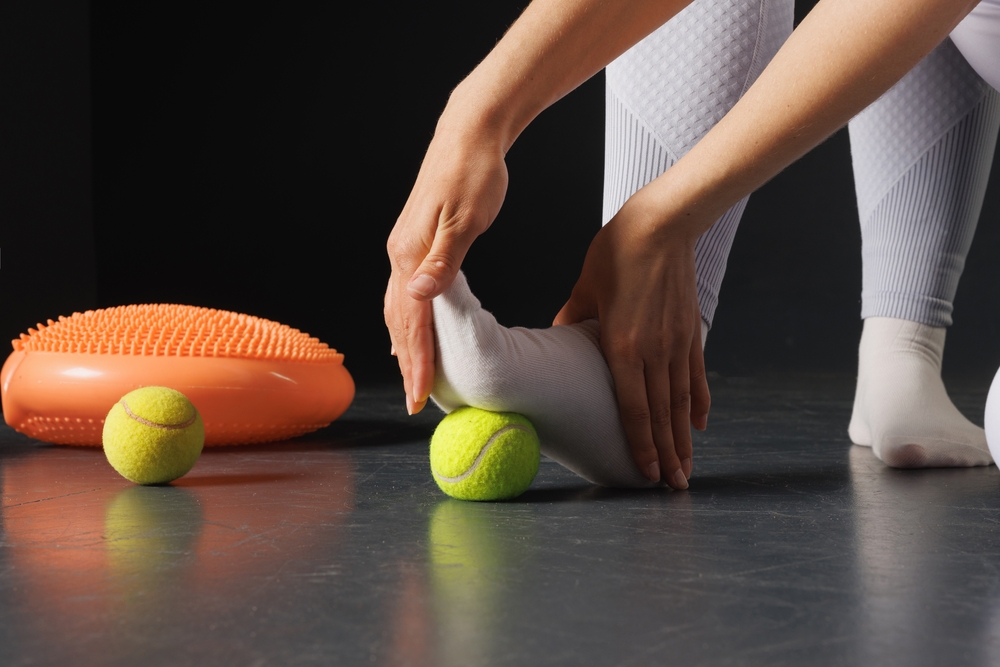
Balance boards, foam pads, or compliant surfaces increase the demand on proprioceptive systems. The ankle must react more quickly to maintain alignment. Progression is guided carefully to avoid overload.
Stage 4: Reactive and Functional Drills
Later stages incorporate agility patterns, hopping drills, and directional changes. For athletes, sport specific movements are added. For daily function, stair descent and uneven ground simulations are included.
Integrating Strength and Mobility
Balance training is most effective when combined with calf strengthening, intrinsic foot muscle activation, and restored ankle mobility. Limited dorsiflexion or muscle weakness can undermine stability efforts.
Measuring Progress
Improvement is tracked through increased single leg stance duration, reduced sway, symmetrical hop performance, and absence of giving way episodes. Objective testing ensures readiness before returning to high demand activity.
Common Mistakes in Ankle Rehab
Stopping rehabilitation when pain subsides is a frequent cause of recurrence. Pain reduction does not equal full neuromuscular recovery. Skipping progressive balance work leaves the joint vulnerable.
Benefits Beyond Injury Recovery
Balance training enhances coordination, reduces fall risk, and improves athletic performance. Strong proprioceptive control contributes to efficient movement patterns across the lower limb.
When to Seek Professional Guidance
If you experience repeated ankle sprains, feel unstable during walking, or lack confidence returning to sport, structured balance assessment is recommended. A tailored program ensures safe and effective progression.
Balance training for ankle rehabilitation restores more than stability. It rebuilds confidence, reaction speed, and functional strength. With structured progression and measurable outcomes, you can move with assurance on any surface. Book your assessment at Adam Vital Physiotherapy & Rehabilitation Center and take the next step toward resilient ankles and sustained performance.
